It's not your imagination. Cannabis dispensaries are opening across New Jersey at lightning speed, seemingly overnight, and municipalities are eager to approve new ones for just about any operator holding a state retail license.
The pace is striking. In the few years since New Jersey legalized adult-use cannabis, an entire retail category has materialized from nothing — and it is still expanding fast.
How we got here
New Jersey voters approved recreational cannabis through a constitutional ballot referendum in November 2020. The implementing law followed shortly after: the Cannabis Regulatory, Enforcement Assistance, and Marketplace Modernization Act (CREAMMA), signed by Governor Phil Murphy on February 22, 2021. Legal adult-use sales began April 21, 2022.
CREAMMA created the Cannabis Regulatory Commission (CRC), which handles state licensing across six classes of operators — including the retail license that matters for strip-center landlords. Critically, the law left zoning control with the municipalities. Each town decides whether to permit cannabis businesses at all, how many, and where. Many New Jersey towns responded by designating cannabis-friendly retail zones, and license holders have been racing to fill them.
For a commercial landlord, this has created an unusual dynamic: a brand-new tenant category, flush with capital, actively hunting for space.
The offers are good. Genuinely good.
I've been approached by several cannabis retail operators over the years, each asking about vacancies. And I'll be honest about what they bring to the table, because it's worth understanding why this is a real decision and not an easy one.
They offer premium rents — well above what most of my other tenants pay per square foot. They typically don't ask for a tenant improvement allowance, which is almost unheard of. And they come with plans to invest significantly into their interior buildouts, often hundreds of thousands of dollars, because dispensaries are heavily regulated and built to a high standard.
On paper, a cannabis dispensary is close to an ideal tenant: high rent, no TI, serious capital behind them.
And still — in most of my centers, I say no. Here's why.
1. Co-tenancy resistance
A strip center is an ecosystem, not a collection of independent leases. The tenants affect one another. And several of the neighborhood businesses I most want in my centers — particularly sit-down restaurants — will resist locating in the same complex as a cannabis retailer.
When I sign a dispensary, I'm not just filling one bay. I'm potentially making my other bays harder to lease to the tenants who build a stable, family-friendly center. That's a tradeoff that doesn't show up in the rent number.
2. Over-saturation is a real financial risk
This is the one that concerns me most as a long-term holder.
In one of our core markets along Route 27, we've watched half a dozen dispensaries open within a three-mile radius of one another — several of them just a few hundred feet apart down the same highway. The supply is growing quickly. Demand is not growing at the same rate.
If proliferation continues to outpace demand, these dispensaries will start cannibalizing each other's business. And a tenant whose revenue is being eroded by the dispensary that opened down the road is a tenant who eventually struggles to pay rent and meet lease obligations. Premium rent means nothing if it can't be sustained through the term.
When you underwrite for a long hold the way we do, you're not pricing the tenant's first year. You're pricing their fifth and tenth. An oversaturated category makes that hard to underwrite with confidence.
"Premium rent means nothing if it can't be sustained through the term. We don't price the tenant's first year — we price their fifth and tenth."
3. Buffer requirements can lock out my favorite tenants
Many municipal ordinances require a minimum buffer between a cannabis dispensary and a licensed childcare facility — daycares, for example. That requirement cuts both ways.
If I sign a long-term lease with a dispensary, I may be permanently preventing a daycare from occupying space in the same center for the life of that lease. In a small-to-medium strip center, that's a serious constraint, because childcare tenants typically take larger spaces — exactly the kind of anchor footprint I want to fill well.
And childcare is among my favorite tenant categories, full stop. Daycares, tutoring centers, enrichment services — these are service-based businesses with recurring revenue, strong retention, and long tenure. They're internet-proof and they anchor a center's identity. Trading the ability to land one of those for a dispensary lease is, for me, often a bad trade.
4. Quality-of-life issues
Finally, the day-to-day. Other strip-mall operators I've spoken with report that dispensaries bring quality-of-life challenges to their properties — most commonly patrons consuming cannabis products in the parking lot. It's nearly impossible to police, and it directly affects the image and curb appeal of the center.
The stigma around cannabis hasn't fully faded. It still lives in the minds of most consumers. If a prospective tenant feels that my property isn't a "drug-free" environment, they may think twice about operating there at all. That perception — fair or not — has a cost, and it's borne by the landlord and every other tenant in the center.
A dispensary that wanted to look like a vault
In Chicago's West Ridge neighborhood, a proposed strip-mall dispensary presented a security plan that included armed guards on duty during all business hours, inch-thick armored plating around the perimeter, an 18-inch concrete barrier across the storefront to stop vehicle ramming, extensive camera coverage, and facial-recognition scanning for every patient entering. Neighbors pushed back hard. One resident summed up the worry plainly — that the place would amount to a fortress on the block.
That's the co-tenancy and quality-of-life problem in one image. The security a dispensary may feel it needs can broadcast a message to the rest of the center — and to the neighborhood — that works directly against the family-friendly, drug-free environment most of my other tenants are trying to project.
Source: DNAinfo Chicago, "Neighbors on Edge Over Heavy Security for Proposed Marijuana Dispensary," Dec. 19, 2014. Read the article →
When cannabis retail does make sense
None of this means cannabis is a tenant category I write off entirely. It means location and format are everything. There are three specific situations where a dispensary stops being a liability and starts being a genuinely good deal.
1. Stand-alone, single-tenant properties
The cleanest fit is a freestanding building with no co-tenants at all. A good local example is Liberty Cannabis in North Brunswick, along the Route 1 corridor — a stand-alone dispensary that opened in a new-construction building that looks like it was originally designed for a stand-alone fast-food restaurant, complete with a drive-thru. With its position on one of central New Jersey's most heavily trafficked highways, it has the kind of street visibility most retailers would pay a premium for.
That's close to an ideal setup. A single-tenant pad like the Liberty Cannabis location eliminates almost every issue I have with cannabis tenancy: there's no co-tenancy impact, because there are no neighbors to object, and the quality-of-life concerns become moot when the dispensary is the only destination on the parcel. Nobody's curb appeal suffers but their own. Add in high-visibility highway frontage along Route 1, and you have a location working in the tenant's favor — and the landlord's.
The one risk that doesn't disappear is over-saturation. The long-term success of many of these relatively new businesses is still unproven. But strip away the co-tenancy and quality-of-life problems, and the decision gets a lot simpler.
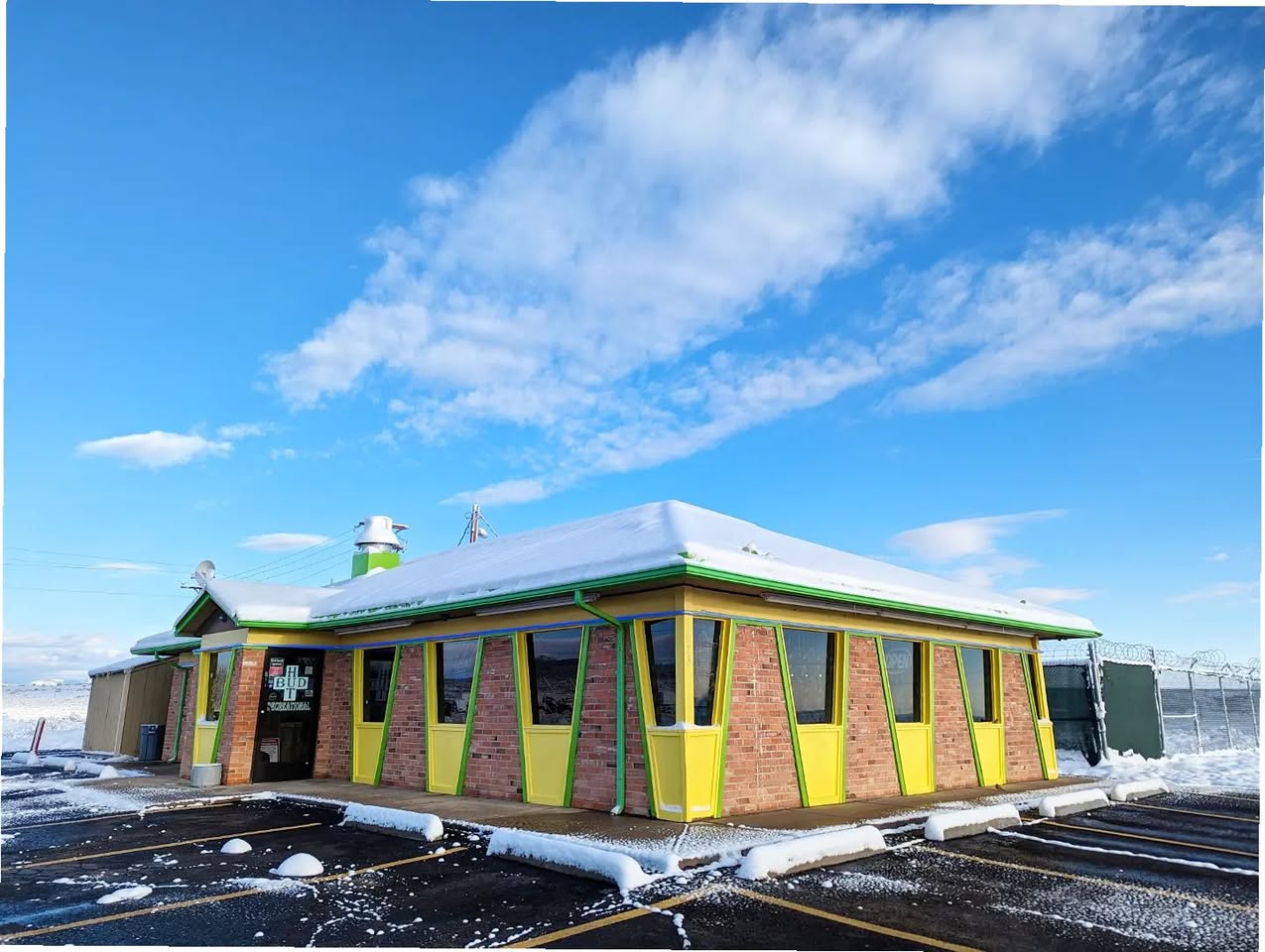
From Pizza Hut to pot shop — the ideal format
This is the Bud Hut, a dispensary in rural Colorado that operates out of a converted former Pizza Hut — the unmistakable hut-shaped roofline still intact. It was featured in the 2024 documentary Slice of Life: The American Dream. In Former Pizza Huts., which profiles old Pizza Hut buildings reborn as everything from churches to karaoke bars.
Beyond the charm, it's a textbook example of the format that makes cannabis retail work: a stand-alone building with no co-tenants. There's no neighbor to object, no shared parking lot to police, and no shopping-center identity to protect. The only destination on the parcel is the dispensary itself — which means almost every objection I have about cannabis in a multi-tenant strip simply evaporates.
Source: "Slice of Life: The American Dream. In Former Pizza Huts." (2024), dir. Matthew Salleh. Photo via the Bud Hut.
2. Urban, walkable storefronts
A handful of dispensaries operate in downtown New Brunswick along George Street — a busy commercial district full of restaurants, bars, and service businesses. In that setting, a dispensary fits right in.
The dynamics that hurt a suburban strip center don't apply downtown. The lack of a dedicated parking lot actually prevents loitering and lingering — there's nowhere to sit and consume. And in a heavily trafficked urban corridor, one dispensary doesn't change the character of the block the way it would in a quiet suburban plaza. The street is already dense and mixed-use.
It's also worth noting that childcare tenants avoid these locations anyway, regardless of cannabis — they need parking for drop-off and pickup, dedicated square footage, and outdoor play areas required under licensing law, none of which a walkable downtown storefront offers. So the buffer-requirement concern that blocks my favorite suburban tenants simply isn't in play here.
3. Strip centers where cannabis strengthens the ecosystem
Finally, there's a specific kind of strip center where a dispensary doesn't just coexist — it actively improves the mix. Smaller strips anchored by convenience stores, smoke shops, liquor stores, fast food, tattoo parlors, and barbershops. In that company, a cannabis dispensary forms a symbiotic relationship with its neighbors rather than repelling them. The customer bases overlap. The traffic reinforces.
These centers exist all over New Jersey, primarily in dense, lower-income markets — and they can be very attractive investments. The tenant mix is internet-proof, the rents are dependable, and a dispensary fits the ecosystem instead of fighting it. In a center like that, cannabis isn't the problem. It's part of the solution.
So where does that leave us?
Not at a hard no — but at a disciplined it depends on the format.
In our core business — small-to-medium suburban strip centers held for the long term — cannabis retail usually creates more problems than the premium rent solves. Co-tenancy friction, saturation risk, buffer requirements that lock out the childcare and service tenants I want most, and quality-of-life issues that erode the whole center. In that specific setting, we still pass more often than not.
But the format determines everything. A stand-alone pad with no neighbors to affect. A walkable downtown storefront where the urban fabric absorbs it. A gritty, internet-proof strip where a dispensary genuinely strengthens the ecosystem. In those cases, cannabis isn't a liability — it's a real opportunity, and we'd take it seriously.
So the position isn't "never." It's "only where the format fits." We underwrite cannabis the same way we underwrite everything else: not on the first year's rent, but on what the asset looks like in year five and year ten. Where the format protects that long-term picture, the answer can absolutely be yes.
And the broader landscape is still young. If new development slows and demand proves itself out over a longer horizon, even the suburban-strip calculus could shift. Markets evolve. Categories mature. We're watching closely — and we're keeping an open mind.
Right now, the curious case of cannabis comes down to a simple test: does the format fit? When it does, we're interested. When it doesn't, premium rent isn't enough to change our minds.